


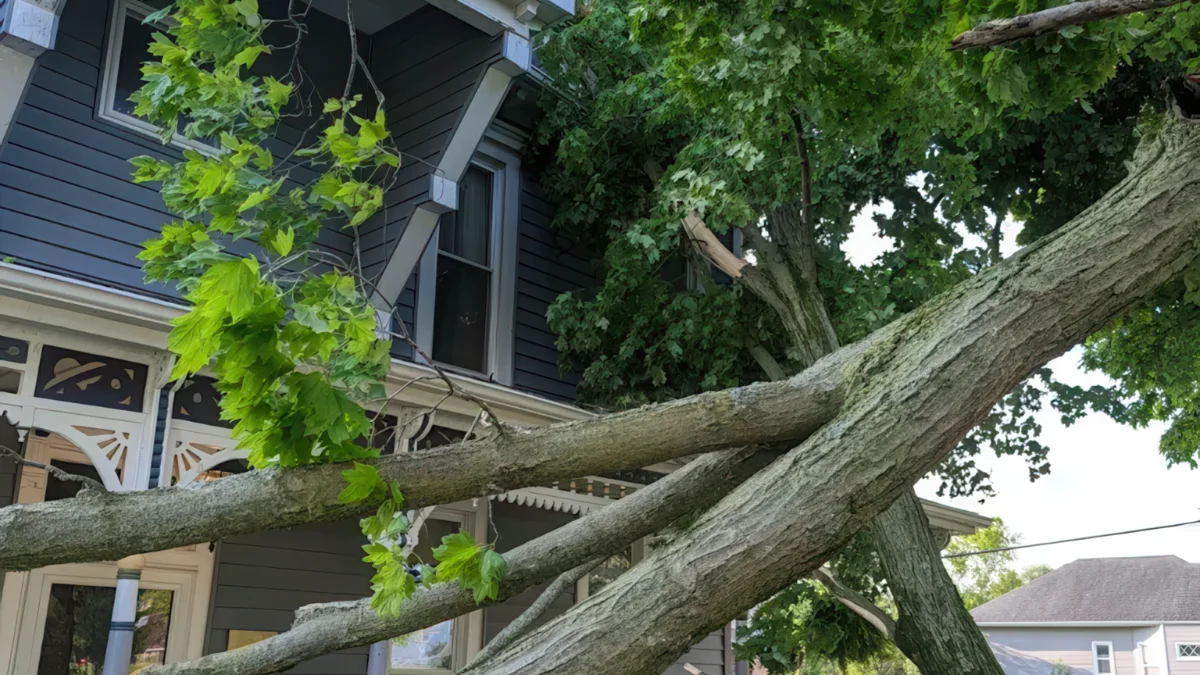
The storm rolled through Gibson County fast. One minute it was a hot, humid southern Indiana afternoon, and the next, the wind was snapping branches and the rain was coming in sideways. If you’re dealing with storm damaged tree removal in Princeton IN or anywhere across the region, you already know the drill. But here’s what most homeowners miss: the damage you can see is rarely the most dangerous part.
After a summer storm, most people walk their property and check the obvious things. Downed branches, debris scattered across the yard, maybe a fence panel that blew over. The problem is that some of the most serious tree damage after a storm doesn’t show up at ground level, and it won’t announce itself until a tree comes down on your roof, your car, or your driveway. Here’s what to look for, and what to do when you find it.
Why Hidden Tree Damage Is More Dangerous Than the Obvious Stuff
A fallen branch in the yard is easy to deal with. You can see it, you can work around it, and you know exactly where it is. Hidden structural damage is different. Cracked trunks, split branch unions, and partially uprooted root systems can cause a tree to fail days or even weeks after the storm with no warning at all.
Southern Indiana summers bring serious weather. High winds, heavy rain, and lightning strikes are common across Vanderburgh County, Knox County, and the communities around Princeton and Vincennes. That kind of stress on a tree doesn’t always show up on the surface. A tree can lose a significant portion of its structural integrity during a storm and still look perfectly healthy from the sidewalk.
That’s why a post-storm tree inspection matters so much. A tree that looks fine today might be ready to fail on the next windy evening. And in neighborhoods across Gibson County and beyond, that means real risk to homes, vehicles, and the people who live there.
6 Types of Hidden Storm Damage to Look For
Cracks in the Trunk or Major Limbs
Look carefully at the trunk and the base of any large limbs after a storm. Vertical cracks running along the bark are a serious warning sign. They mean the wood has split under stress, and the tree may no longer be structurally sound.
Don’t assume a crack that looks small is safe. Even a crack that has partially closed can reopen under the next load, whether that’s a windstorm, heavy rain, or even the weight of new leaf growth. If you spot cracking on a tree near your house in Princeton or out on a rural property in Pike County, treat it as a red flag and get a professional out to take a look.
Hanging or “Widow Maker” Branches
These are branches that broke during the storm but didn’t fall completely. They’re held up by bark, by neighboring branches, or by nothing more than friction and luck. And they can come down without any warning at all.
They’re called widow makers for a reason. A partially broken branch overhead can look stable for days before it drops, and it won’t give you any signal before it does. Walk the area under your trees carefully, look up, and watch for anything that’s hanging at an unnatural angle or resting on another branch in a way it wasn’t before.
Root Heaving and Soil Disturbance
Get close to the base of your trees and look at the ground. Raised soil, cracked ground near the root zone, or exposed roots are all signs that the root system has shifted during the storm. This is called root heaving, and it means the tree’s anchor in the ground has been compromised.
A tree with a damaged root system can fall in surprisingly moderate wind. You don’t need another severe storm to bring it down. This kind of damage is especially common after heavy rain saturates the soil and high winds push against the canopy at the same time, which is exactly the kind of weather that moves through southern Indiana in July and August.
Bark Damage and Wounds
Wind-driven debris, lightning strikes, and falling limbs can all strip bark from a tree. It might not look that serious at first glance, but bark is the tree’s protective layer. When it’s gone, the inner wood is exposed to disease, insects, and decay.
Here’s the thing about bark damage: a tree can look completely healthy for months after losing a significant section of bark before declining rapidly. By the time the visible decline starts, the damage is often deep and the tree is already a hazard. If you see areas of missing or torn bark on a tree near Patoka, Haubstadt, or anywhere else in the area, that’s worth noting and getting checked out.
Leaning That Wasn’t There Before
This one is straightforward but easy to miss if you’re not paying attention. A tree that’s leaning at a new angle after a storm has experienced some kind of structural failure, whether in the root system, the trunk, or both.
New lean is a serious warning sign. It requires a professional assessment right away. Don’t wait and see on this one. A leaning tree near a structure, a driveway, or a power line in Vincennes or Princeton is not a situation that gets better on its own.
Broken Branch Stubs Left in the Canopy
When a branch breaks mid-limb during a storm, it leaves a stub behind. That stub is a decay entry point. Rainwater, insects, and fungi can all work their way into that exposed wood and begin breaking down the tree from the inside.
Left untreated, these stubs rot back into the trunk over time and compromise the tree’s structural integrity. It’s a slow process, but it’s a real one. Proper pruning after a storm, handled by a certified professional, removes those stubs correctly and helps the tree close the wound. It’s one of the most overlooked parts of storm damage tree cleanup.
When to Call for Emergency Tree Removal vs. When to Wait
Some situations need immediate attention. Call for emergency tree removal right away if a tree is leaning toward a structure, if hanging branches are directly over a roof or driveway, if you can see visible trunk cracks, if there’s root heaving at the base of the tree, or if a tree is already on or touching a structure.
Other situations are still serious but can be scheduled rather than handled as emergencies. Bark damage, broken stubs in the canopy, and general storm cleanup fall into this category. You’ll want to get them addressed soon, but they don’t necessarily require a middle-of-the-night call.
The most important rule here: don’t try to handle damaged trees yourself. Storm-damaged trees are unpredictable and dangerous. A cracked or partially broken tree stores a tremendous amount of energy, and when you cut it, that energy releases in ways that are almost impossible to anticipate. That’s a job for trained professionals with the right equipment. Whitledge Tree Service’s 24/7 emergency storm damage tree removal in southern Indiana is available around the clock for exactly these situations.
How Whitledge Tree Service Handles Storm Damage in Southern Indiana
Whitledge Tree Service has been responding to storm damage across southern Indiana since 2008. That’s almost 20 years of working through the aftermath of summer storms in Gibson County, Knox County, Vanderburgh County, Pike County, Warrick County, and Posey County. The team knows this region, the weather patterns, and the kinds of tree failures that show up here.
One of the things that sets Whitledge Tree Service apart is equipment capability. The company operates the largest crane in the service area, a 120-foot crane that makes it possible to remove trees in difficult-access locations that would be impossible or unsafe to handle any other way. When a large tree comes down in a tight spot in Princeton or on a rural property outside Hazelton, that crane is the difference between a clean removal and a much bigger problem.
Whitledge Tree Service also works directly with property insurance companies on behalf of clients. If a storm has damaged your property and you’re not sure what your coverage looks like, that’s a conversation Whitledge Tree Service can help you navigate. All storm damage assessments come with a free estimate. You can get started at Whitledge Tree Service’s free estimate for storm damaged tree removal in Princeton.
Insurance and Storm Damage Tree Removal
A lot of southern Indiana homeowners don’t realize that their property insurance may cover storm damage tree removal, especially when a tree has fallen on a structure. It depends on your policy and your insurance company, but it’s always worth checking before you pay out of pocket.
Here’s what to do first: document everything. Before any cleanup starts, take photos of every tree, every downed branch, every piece of damage you can see. Get wide shots and close-ups. That documentation matters when it comes time to file a claim.
Call Whitledge Tree Service before you call your insurance company. Whitledge Tree Service has extensive experience working with insurers and can help you understand what’s likely covered and what to expect from the process. Whitledge Tree Service’s insurance claim coordination for storm damage in Gibson County is a service the company provides as part of its commitment to the communities it serves. Having someone in your corner who knows how these claims work can make a real difference in the outcome.
Frequently Asked Questions
How do I know if a tree needs emergency removal after a storm or if it can wait?
Whitledge Tree Service recommends looking for a few specific signs that require immediate attention. If a tree in Princeton or anywhere in southern Indiana is leaning toward a structure, if branches are hanging directly over a roof or occupied area, if you see visible cracks in the trunk, or if a tree is already touching a structure, those situations should not wait. Whitledge Tree Service offers 24/7 emergency response for exactly these scenarios. For damage that’s real but not immediately threatening, like bark wounds or broken stubs in the canopy, Whitledge Tree Service can schedule an assessment and handle the cleanup on a priority basis. When in doubt, call and describe what you’re seeing.
Does homeowner’s insurance cover storm damage tree removal in southern Indiana?
It depends on your specific policy, but Whitledge Tree Service has worked with many homeowners across Princeton, Vincennes, and the surrounding area to navigate insurance claims after storms. In many cases, insurance covers tree removal when a tree has fallen on a structure, and sometimes even when it’s blocking a driveway or access point. Whitledge Tree Service works directly with property insurance companies on behalf of clients and can help you understand what your policy is likely to cover before you file. The key is to document all damage with photos before any cleanup begins. Whitledge Tree Service can coordinate the claims process and advocate for you throughout.
What makes Whitledge Tree Service different from other tree services in the area?
Whitledge Tree Service has been serving southern Indiana since 2008, which means nearly 20 years of experience with the specific weather patterns and tree species found in Gibson County, Knox County, and across the region. The company operates the largest crane in the service area, a 120-foot crane that handles complex removals in tight or difficult-access locations that other companies simply can’t manage safely. Every member of the Whitledge Tree Service team is from southern Indiana, so this is a locally rooted company serving its own community. Add in 24/7 emergency availability, insurance claim coordination, and free estimates for storm damage in Princeton and beyond, and the difference becomes clear.
How quickly can Whitledge Tree Service respond after a storm in southern Indiana?
Whitledge Tree Service offers 24/7 emergency tree service and specializes in removing trees from structures. For immediate hazards, including trees on roofs, trees blocking exits, or actively dangerous hanging branches in Princeton or anywhere across the service area, the team responds around the clock. Whitledge Tree Service serves a wide area across southern Indiana, including communities in Gibson County, Knox County, Vanderburgh County, and surrounding counties, so response times are built around the geography the company knows well. For non-emergency storm cleanup, Whitledge Tree Service prioritizes based on the level of risk and can typically schedule assessments quickly after a storm event. Free estimates are available for all storm damage situations.
What should I do immediately after a storm while waiting for Whitledge Tree Service to arrive?
The first thing to do is stay away from damaged trees, especially any tree that’s leaning, has visible trunk damage, or has branches hanging in the canopy. Whitledge Tree Service advises southern Indiana homeowners not to walk under compromised trees or attempt any removal themselves, even for branches that look manageable. Storm-damaged trees are unpredictable, and what looks like a simple cleanup can become a serious injury situation fast. While you wait, document everything with photos, both wide shots and close-ups of specific damage. That documentation will be valuable for any insurance claim Whitledge Tree Service helps you coordinate. If the situation is an active emergency in Princeton or anywhere in the region, reach out to Whitledge Tree Service right away through whitledgetreeservice.com.
Storm Damage in Southern Indiana? Whitledge Tree Service Responds 24/7.
Whitledge Tree Service has served Princeton, Vincennes, Evansville, and communities throughout southern Indiana since 2008. Our licensed, insured team provides 24/7 emergency storm damage tree removal, with the largest crane in the service area for complex and difficult-access removals. We work directly with property insurance companies on your behalf. Free estimates. Visit whitledgetreeservice.com for immediate assistance.